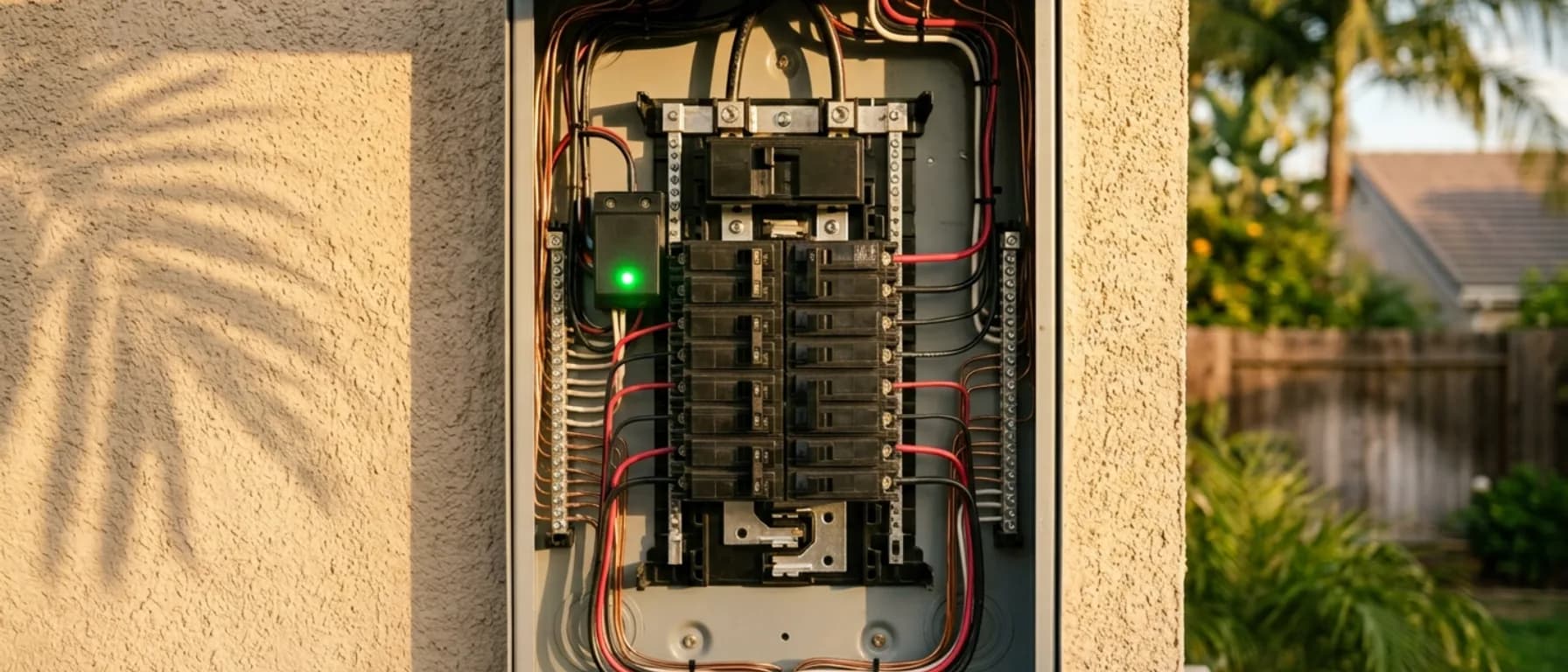
Most homeowners in Lake Elsinore think of a power surge as a lightning strike. Lightning is the dramatic version, but it is not the one that kills your appliances. The surges that do the real damage are small, frequent, and generated inside the grid and inside your own home — and they add up over years until something expensive stops working.
Where Surges Actually Come From
Roughly 80% of the voltage transients a home experiences are internally generated. Every time a large inductive load switches off — an AC compressor, a pool pump, a well pump, a refrigerator — it dumps energy back onto your wiring. The rest come from the utility side: line switching, capacitor bank operations, tree contact, transformer faults, and the restoration spike when power comes back after a Public Safety Power Shutoff.
Riverside County gets all of these. Summer monsoon cells roll over the Ortega and Elsinore hills, SCE switches circuits under heat load, and PSPS events end with thousands of homes re-energizing at once.
Why It Matters More Than It Did 20 Years Ago
An older home was full of resistive loads — incandescent bulbs, mechanical timers, motors with no electronics. They shrug off a 600-volt transient. A modern home is full of circuit boards: the inverter in your heat pump, the control board in your furnace, the LED drivers in every recessed can, the Wi-Fi radio in your thermostat, the charging module in your EV charger. Those boards fail at voltages a light bulb would never notice.
The typical complaint we hear is not "lightning fried my TV." It is "my LED cans started flickering and dying early" or "the control board on my two-year-old AC went out again." That is surge damage accumulating.
How Layered Surge Protection Works
Proper protection is layered, not a single device.
- Type 1 or Type 2 service entrance SPD. Installed at the meter or inside the main panel, this device clamps the big stuff coming off the utility line. This is the whole-home surge protector people usually mean.
- Type 2 at subpanels. If you have a subpanel feeding a garage, shop, pool equipment pad, or ADU, a second device there protects those loads and catches transients generated by the pumps and motors out there.
- Type 3 point-of-use strips. The plug strips behind your TV and computer handle the last small residual. They are not a substitute for panel-level protection — they were never designed to absorb a utility-side event.
The Electrical Safety Foundation International recommends exactly this layered approach for homes with significant electronic loads.
What to Look For in a Device
Surge protective devices are rated by surge current capacity in kiloamps (kA) per phase and by voltage protection rating (VPR) — the let-through voltage. Higher kA means longer service life; lower VPR means tighter clamping. For a typical 200-amp residential service we install devices in the 50-80 kA range with a VPR at or below 700V. Skip the bargain units; the internal metal oxide varistors degrade with every event and cheap devices burn through their life quickly.
Look for a unit with a visible status indicator and, ideally, an audible alarm. An SPD that has sacrificed itself protecting your house looks exactly like a working one unless it tells you otherwise.
Installation Reality in an Older Panel
A whole-home SPD needs two adjacent breaker spaces and a short, straight conductor run to the bus. "Short and straight" matters more than most people realize — every extra inch of lead length raises the let-through voltage. If your panel is full, or if it is one of the obsolete brands that shows up constantly in Lake Elsinore and Wildomar home inspections, adding surge protection is the right moment to talk about a panel upgrade instead of forcing a device into a panel that is already at its limit.
What It Costs and What It Protects
Installed, a quality service-entrance SPD on an existing panel with available space typically runs a few hundred dollars. Compare that against a single heat pump control board, an EV charger, or the LED retrofit in a whole house. For homes that have added solar, a battery, a dedicated circuit for an EV charger, or any smart home automation, it is among the cheapest insurance in the panel.
One Caveat
Surge protection does not replace grounding. An SPD works by diverting energy to ground, so if your grounding electrode system is undersized, corroded, or missing the bonding jumpers required by current code, the device cannot do its job. We check grounding every time we install one — and in pre-1990 homes, we find problems more often than not.
Get Your Panel Evaluated
Westek Electric Corp. installs whole-home surge protection throughout Lake Elsinore, Wildomar, Murrieta, and Temecula, and we verify your grounding and bonding as part of the job. Call (909) 996-6678 and we will tell you honestly whether your panel can take a device today or needs work first.