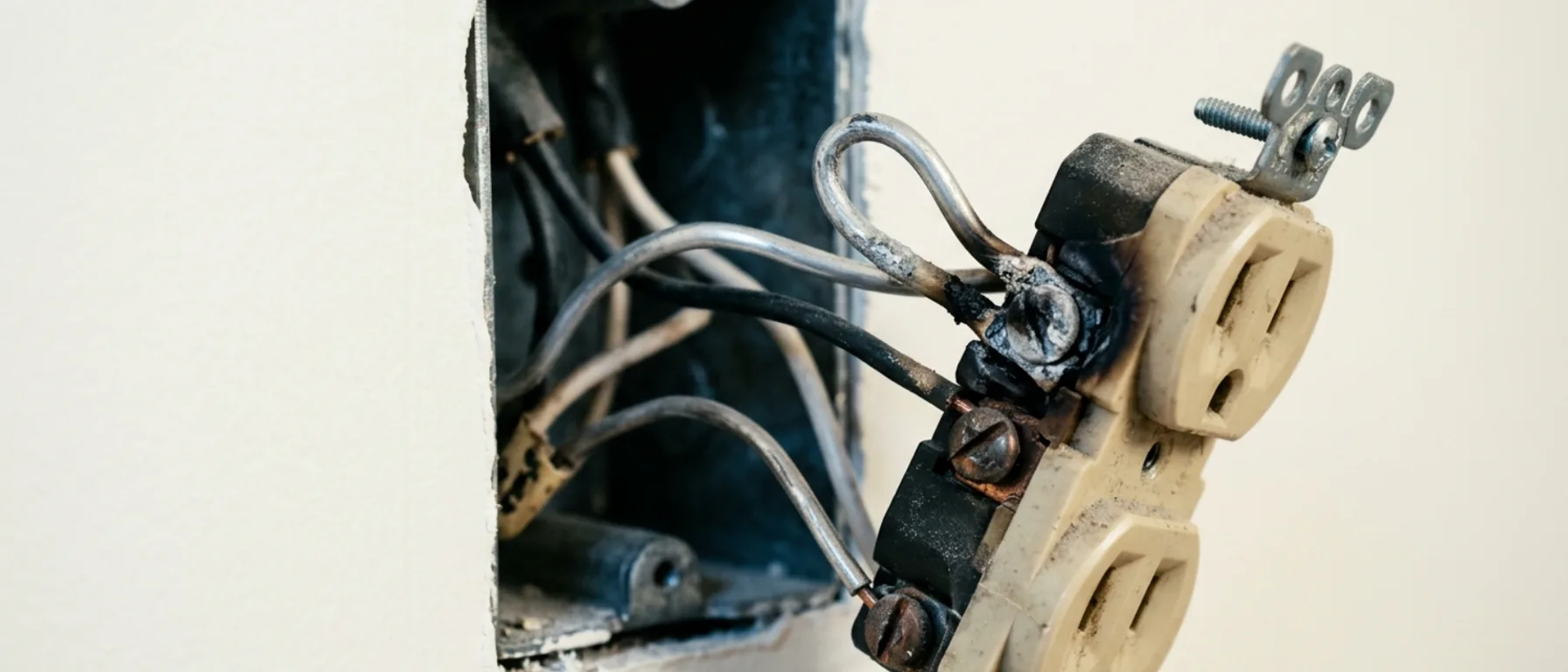
If your home in Hemet or San Jacinto was built between roughly 1965 and 1975, there is a meaningful chance the branch circuits behind your walls are aluminum rather than copper. Copper prices spiked during that decade, builders switched, and millions of American homes were wired with solid aluminum conductors on 15- and 20-amp circuits.
This is not a reason to panic. It is a reason to find out, because the failure mode is a fire at a connection point, and the fix is well understood.
Why Aluminum Branch Circuits Are a Problem
Aluminum is a perfectly good conductor — it is still used today for service entrance and feeder conductors, correctly and safely. The problem was specific to small-gauge solid aluminum at device terminations.
- Thermal expansion. Aluminum expands and contracts more than copper as the circuit heats and cools, which gradually loosens screw terminations.
- Oxidation. Aluminum oxide forms readily and is a poor conductor, unlike copper oxide. Resistance builds at the connection.
- Creep. Under sustained pressure, aluminum deforms and the connection loosens further.
- Galvanic issues where aluminum contacts dissimilar metals in a damp environment.
All four converge at the same place: the screw terminal on an outlet, switch, or splice. A loose connection heats, the heat accelerates the loosening, and eventually you get glowing connections inside a plastic box. The U.S. Consumer Product Safety Commission found that homes wired with aluminum branch circuits before 1972 were substantially more likely to have a connection reach fire hazard conditions than comparable copper-wired homes.
How to Tell If You Have It
Do not open outlets yourself. There are safer places to look:
- At the panel, with the cover on, you can often see the cable jackets entering. Aluminum branch cable is commonly marked "AL" or "ALUMINUM" on the jacket.
- In the attic or garage, exposed cable runs may show the same printing.
- Silver-colored conductor rather than copper-colored where any wiring is visible.
- Symptoms: warm cover plates, outlets that work intermittently, a faint burning or fishy odor near a device, flickering on one circuit, or lights that dim when a load kicks on.
The definitive answer comes from a licensed electrician pulling a few devices and inspecting terminations.
The Three Repair Options
Only three approaches are recognized as acceptable remediation. Everything else is a shortcut.
- 1. COPALUM crimp. A copper pigtail is joined to the aluminum conductor with a specialized crimp tool that creates a cold weld, then insulated. This is regarded as the gold standard fix. The limitation is availability — it requires certified installers and specific tooling, and finding one has become harder over time.
- 2. AlumiConn connectors. A listed set-screw lug that joins aluminum to a copper pigtail with anti-oxidant compound and torqued terminations. Far more widely available than COPALUM, accepted by inspectors, and appropriate for most homes. Correct torque matters enormously here, which is why this is not a DIY job.
- 3. Complete rewiring. Replacing the aluminum branch circuits with copper. It is the most expensive and most disruptive option, and it is also the permanent one. If you are already remodeling, opening walls, or upgrading a panel, full rewiring often makes the most financial sense because the access cost is already being paid.
What is not acceptable: standard wire nuts on aluminum-to-copper splices, "CO/ALR" devices as a whole-house solution on their own, or purple twist connectors used outside their listing. These show up in homes constantly and they do not resolve the hazard.
The Insurance Angle
Carriers ask about aluminum branch wiring on applications, and in California's tightened homeowners market some will decline coverage or charge significantly more without documented remediation. If you are buying, renewing, or shopping carriers, having a licensed electrician's remediation documentation in hand is genuinely valuable.
What to Do While You Decide
Do not overload circuits with space heaters or window AC units on aluminum-wired outlets. Replace anything that feels warm to the touch. And do not ignore a burning smell — turn that circuit off at the panel and call an electrician the same day.
Get an Assessment
Westek Electric Corp. inspects and remediates aluminum branch wiring in Hemet, San Jacinto, Menifee, and throughout Riverside County, and we handle the panel work and code corrections that usually go with it. Call (909) 996-6678 for an evaluation.