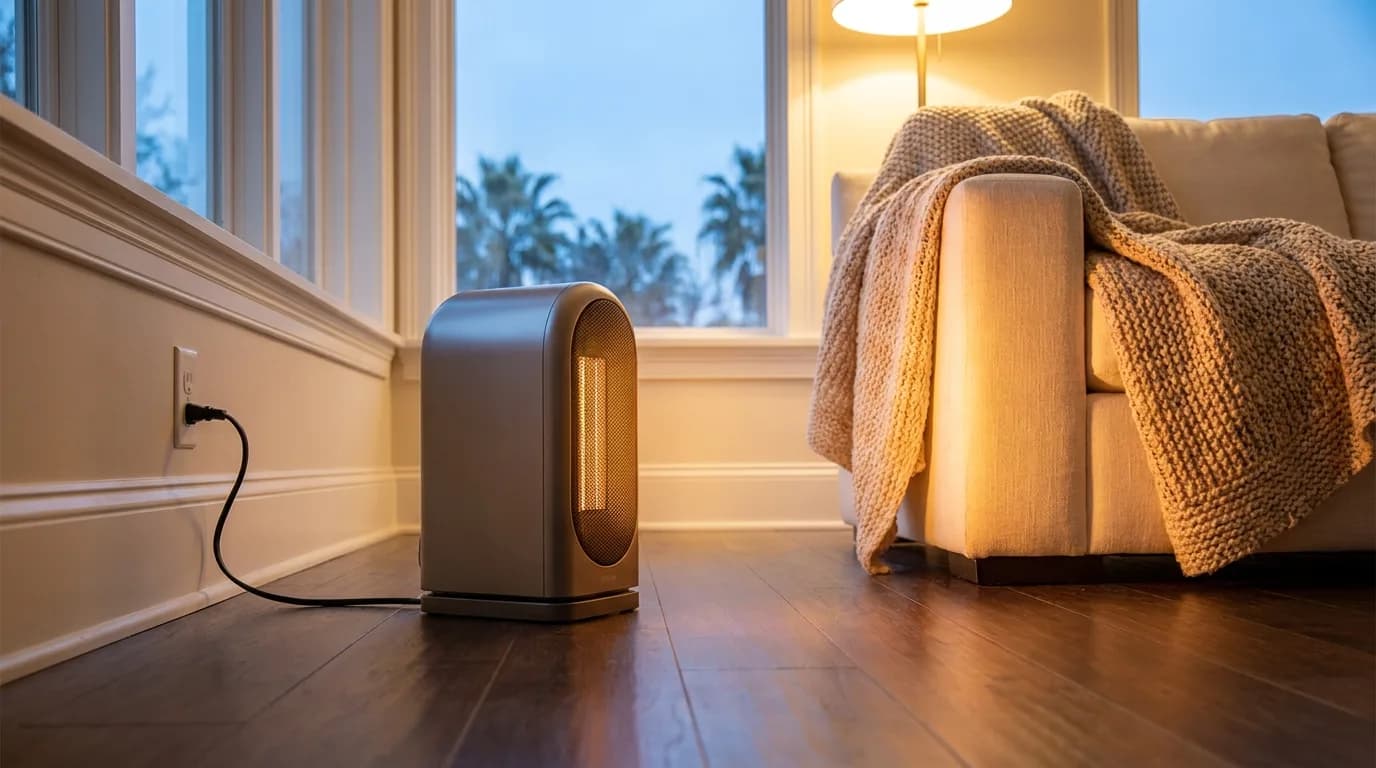
People are often surprised by how cold inland Riverside County gets once the sun goes down in late fall. Overnight lows in Menifee, Hemet, and the higher parts of the valley drop into the 30s, and out come the portable heaters — usually into whatever outlet is closest.
Heating equipment is one of the leading causes of home fires in the United States, and portable space heaters account for the large majority of those deaths. The U.S. Fire Administration puts the peak squarely in the winter months. Nearly all of it is preventable.
The Number That Matters: 1,500 Watts
Virtually every portable electric heater sold draws about 1,500 watts on high. On a 120-volt circuit that is 12.5 amps.
A standard 15-amp household circuit has a continuous-load limit of 12 amps. A 20-amp circuit allows 16. So one space heater on high essentially consumes an entire 15-amp circuit by itself, with nothing left over.
That is the whole problem in one sentence: a space heater is not a small appliance. It is the largest plug-in load most people own.
What Overload Actually Does
If the breaker trips, the system worked. The dangerous cases are the ones where it does not:
- Undersized or damaged extension cords heat up along their length, often under a rug or behind furniture where you cannot see or smell it.
- Worn receptacles lose spring tension, so the plug sits loose, resistance rises, and the outlet face heats and discolors.
- Backstabbed wiring — conductors pushed into the quick-connect holes on the back of a receptacle rather than wrapped under the screws — is a common weak point in tract homes from the 1980s and 1990s.
- Aged breakers may not trip reliably at all. We cover this in the warning signs your panel needs upgrading.
Rules That Actually Prevent Fires
- Plug heaters directly into a wall outlet. No extension cord, no power strip, no surge protector, no smart plug. Those devices are generally not rated for a sustained 12.5-amp load.
- One heater per circuit. Not per outlet — per circuit. Two outlets in the same room are usually the same circuit.
- Three feet of clearance from bedding, curtains, upholstery, and laundry.
- Hard floors only, never carpet, and never under a desk where fabric can contact it.
- Buy units with tip-over and overheat shutoff and a recognized testing-lab mark.
- Never run one while asleep or out of the house.
- Touch-test the plug and outlet after 20 minutes. Warm is a warning. Hot means stop immediately and call an electrician.
Older Homes Have Less Headroom
A 1960s or 1970s home in Hemet or San Jacinto may have the entire bedroom wing on one or two circuits. Add a heater, a TV, a phone charger, and a lamp, and you are at the limit before anyone has done anything unusual. If the house still has two-prong ungrounded outlets, or aluminum branch wiring, the margin is thinner still.
If you find yourself relying on heaters every winter, the real fix is usually a dedicated circuit in the rooms that need it, or addressing why the central heat is not keeping up.
The December Compounding Problem
Space heaters arrive at the same time as holiday decorations, and they frequently end up on the same circuits. If your living room circuit is already carrying a tree, a mantel display, and exterior lights, adding 12.5 amps of heater is how a season ends badly. Plan both together — our guide to holiday lighting without the blown circuits covers the lighting half.
Signs You Should Call Someone
- A breaker that trips whenever the heater runs, or needs resetting repeatedly
- An outlet or plug that is warm, discolored, or smells faintly of hot plastic
- Lights that dim noticeably when the heater cycles on
- A buzzing or crackling sound from a receptacle or switch
- Scorch marks of any kind
That last one is not a wait-and-see item. Turn the circuit off at the panel.
Get Ahead of It
Westek Electric Corp. tests circuits under load, replaces worn receptacles and tired breakers, and adds dedicated circuits throughout Menifee, Hemet, San Jacinto, Temecula, and Murrieta. Call (909) 996-6678 before the first cold snap rather than after something gets warm that should not.