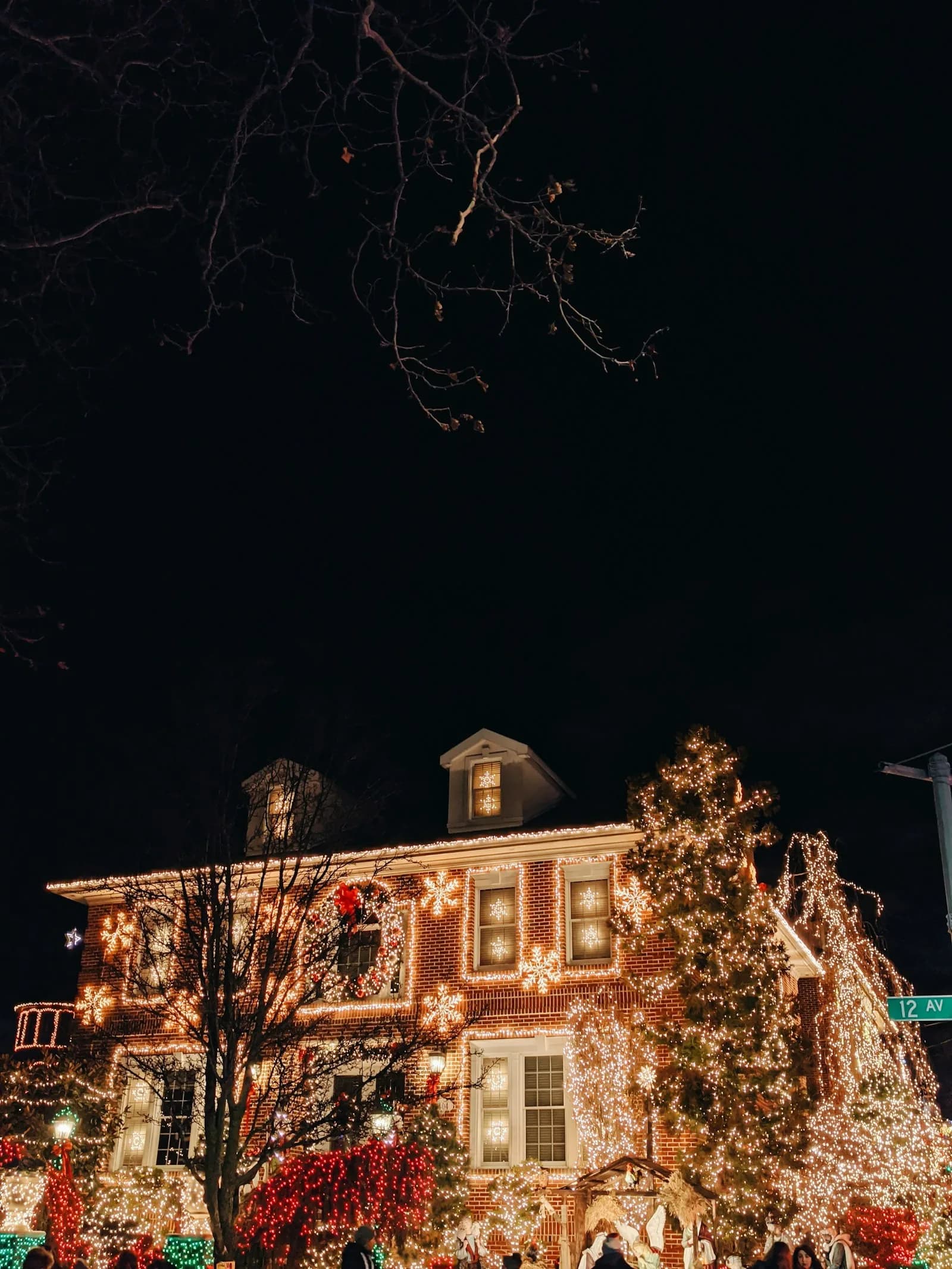
Every December we get calls from Temecula homeowners whose holiday display worked great on Thanksgiving weekend and started tripping breakers by Christmas Eve. Almost every one of these calls comes down to the same three issues — circuit overload, damaged extension cords, and outdated incandescent strings. Here is how to build a holiday display that stays lit all season without a service call.
Know Your Circuit Capacity
A standard 15-amp exterior receptacle circuit can handle about 1,440 watts continuously — 80% of the 1,800-watt maximum, per code. Traditional incandescent C7 or C9 bulbs pull 5-7 watts each. A single strand of 100 traditional mini-lights pulls about 40 watts, but strands connected end-to-end add up fast. Layer in inflatables (each 25-100 watts), animated projectors, and yard art motors, and you are past 1,440 watts before you know it.
The fix: know which receptacles are on which breaker, spread the display across multiple circuits, and add up your wattage before you plug in.
Switch to LED — Really, All of It
A strand of 100 LED mini-lights pulls about 4-6 watts. That is roughly 90% less energy than incandescent for the same visual output. You can connect 40-plus LED strands end-to-end on the same circuit that used to support 4-5 incandescent strands. If your electric bill jumped in December and you are still running incandescent, switching to LED lighting is the single biggest change you can make.
Use Outdoor-Rated Cords and Timers
Every year we see melted extension cords running through wet grass, indoor-rated cords used outside, and undersized cords carrying big loads. Rules that will save you a service call:
- Only outdoor-rated cords outside. Look for the "W" designation and a heavy jacket.
- Match the cord gauge to the load. 16 AWG for light-duty runs under 25 feet; 14 AWG or 12 AWG for anything longer or heavier.
- Never daisy-chain cords. One outdoor cord to one strand or one splitter — not three cords in a line.
- Use outdoor timers with photocells, not indoor timers with cords running under the door.
GFCI Everything Outside
Every outdoor receptacle used for holiday lighting must be GFCI-protected. GFCIs trip if water gets into a connection — which is annoying but is the exact behavior that keeps someone from getting shocked when they touch a Christmas light connection with wet hands. If your GFCI is nuisance-tripping, the fix is drier connections (elevate splices off the ground, use weatherproof plug covers) — not disabling the GFCI. The National Fire Protection Association's winter holiday safety guidance reports that electrical failures cause a significant share of December home fires — GFCI protection and proper cord use are the biggest preventive measures.
Consider Permanent Exterior Lighting
Permanent color-changing LED eaves lighting (sometimes called "everlights") has become popular in Temecula and Murrieta over the last few years. Installed under the roofline, it functions as festive holiday lighting in December, patriotic red-white-blue for the Fourth of July, purple and orange for Halloween, or warm white as year-round outdoor accent lighting. You never climb a ladder, never take down lights in January, and never fight tangled strings again. It is a serious upgrade for anyone who does holiday lighting seriously.
For year-round design principles, see our outdoor lighting design tips.
Landscape Uplighting Adds Depth
Low-voltage landscape uplighting aimed at palm trees, olive trees, or the front of your house makes an inflatable-free holiday display look expensive. Combined with warm white LED eaves lighting, you get a display that reads as tasteful and coordinated rather than chaotic.
If you find yourself re-running temporary cords every December, a permanent landscape and security lighting system solves the problem once.
Need Help Before the Season Starts?
Westek Electric Corp. installs permanent eaves lighting, adds dedicated exterior circuits for heavy displays, and handles holiday lighting installations across Temecula, Murrieta, and Menifee. Call (909) 996-6678 before Thanksgiving to lock in a slot — we book up fast every year.