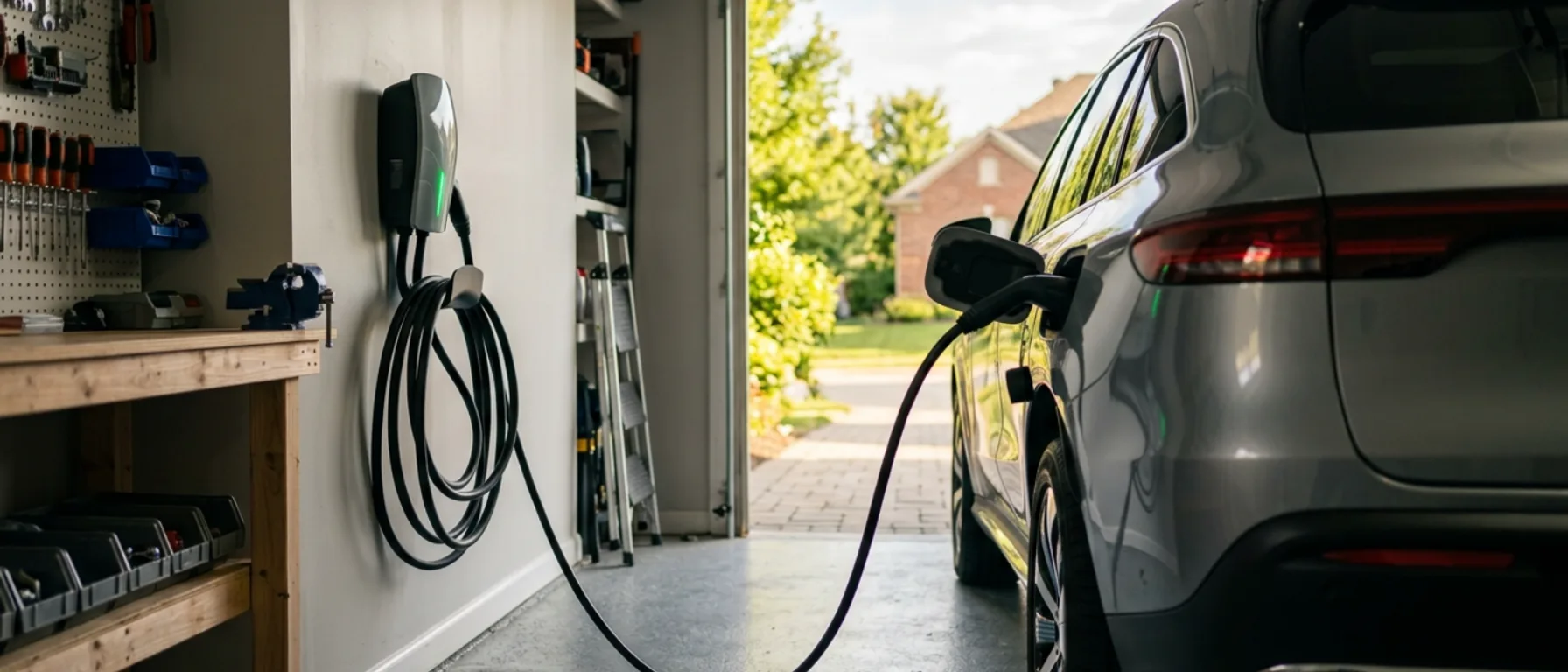
Most people shopping for a home EV charger start with the wrong question. They ask which charger is fastest. The better question is how many miles you actually drive between the time you park at night and the time you leave in the morning — because in the Temecula Valley, the answer determines everything.
The Only Math That Matters
You have roughly 12 hours parked at home overnight. Whatever you drove that day has to go back into the battery in those 12 hours. That is the whole calculation.
- Level 1 (standard 120V outlet): about 3-5 miles of range per hour. Over 12 hours, 36-60 miles.
- Level 2 at 32 amps (240V, 40A circuit): about 25-30 miles per hour. Over 12 hours, 300+ miles.
- Level 2 at 48 amps (240V, 60A circuit): about 35-44 miles per hour. Over 12 hours, more than most batteries hold.
Notice that both Level 2 options fully refill a typical EV overnight. The 48-amp charger is not meaningfully more useful for daily commuting — it is useful when you come home nearly empty and need to leave again in three hours.
When Level 1 Is Genuinely Enough
If your daily driving is under about 35 miles and you are home every night, a standard outlet keeps up. That covers a lot of people here: a commute inside Temecula or Murrieta, school runs, errands in Old Town. A second household EV that mostly stays local is another common case.
Two conditions, though. The outlet needs to be on a dedicated circuit — not shared with the garage fridge and the freezer — and it should be a properly installed receptacle, not a decades-old outlet fed by a run of 14-gauge wire. A car charging at 12 amps for 12 hours straight is a continuous load, and continuous loads find weak connections.
When You Need Level 2
Move to Level 2 if any of these apply:
- You commute into Orange County, San Diego, or the Inland Empire — an 80 to 120 mile round trip that Level 1 cannot refill overnight
- You have two EVs sharing one charging location
- You drive a large truck or SUV EV, where a mile costs more kilowatt-hours
- You want to charge on solar during the day, which requires the higher rate to use meaningful production in a few peak hours
- Your schedule is unpredictable and you want to be full by morning regardless
For the large majority of these drivers, a 40-amp circuit feeding a 32-amp charger is the sweet spot on cost, panel impact, and speed. See our EV charger installation page for the units we install most often.
What the Circuit Actually Costs You in Panel Space
This is where Temecula Valley homes split into two groups. A 1990s tract home on 100-amp or a crowded 200-amp panel may not have room for a 60-amp charger circuit without a load calculation and possibly a panel upgrade. That same home often has room for a 40-amp circuit.
There is also a middle path many homeowners do not know about: a load-managing charger or an energy management system that lets a charger share capacity with other loads, backing off automatically when the AC and dryer run. That can avoid a panel upgrade entirely. It is worth asking about before you assume you need one.
Hardwired vs Plug-In
A NEMA 14-50 plug-in installation is convenient and portable, and it is the right call for renters or anyone who expects to move. Hardwiring is required above 40 amps, is more reliable long term, and eliminates the receptacle as a failure point. If you are staying in the house, hardwire it.
One warning: cheap 14-50 receptacles are a known failure point under continuous EV load. If you go plug-in, insist on an industrial-grade receptacle. It costs a little more and it does not overheat.
Rates Matter as Much as Amps
Southern California Edison offers EV-specific time-of-use rate plans with much cheaper overnight pricing. Any charger you buy should support scheduled charging so it starts automatically in the cheapest window. The U.S. Department of Energy Alternative Fuels Data Center has a good primer on home charging if you want to compare options in detail.
Get a Load Calculation First
Westek Electric Corp. installs EV chargers throughout Temecula, Murrieta, Menifee, and Lake Elsinore. We run the load calculation, pull the permit, and size the circuit to what you actually drive — not to whatever the biggest number on the box is. Call (909) 996-6678 for a quote.