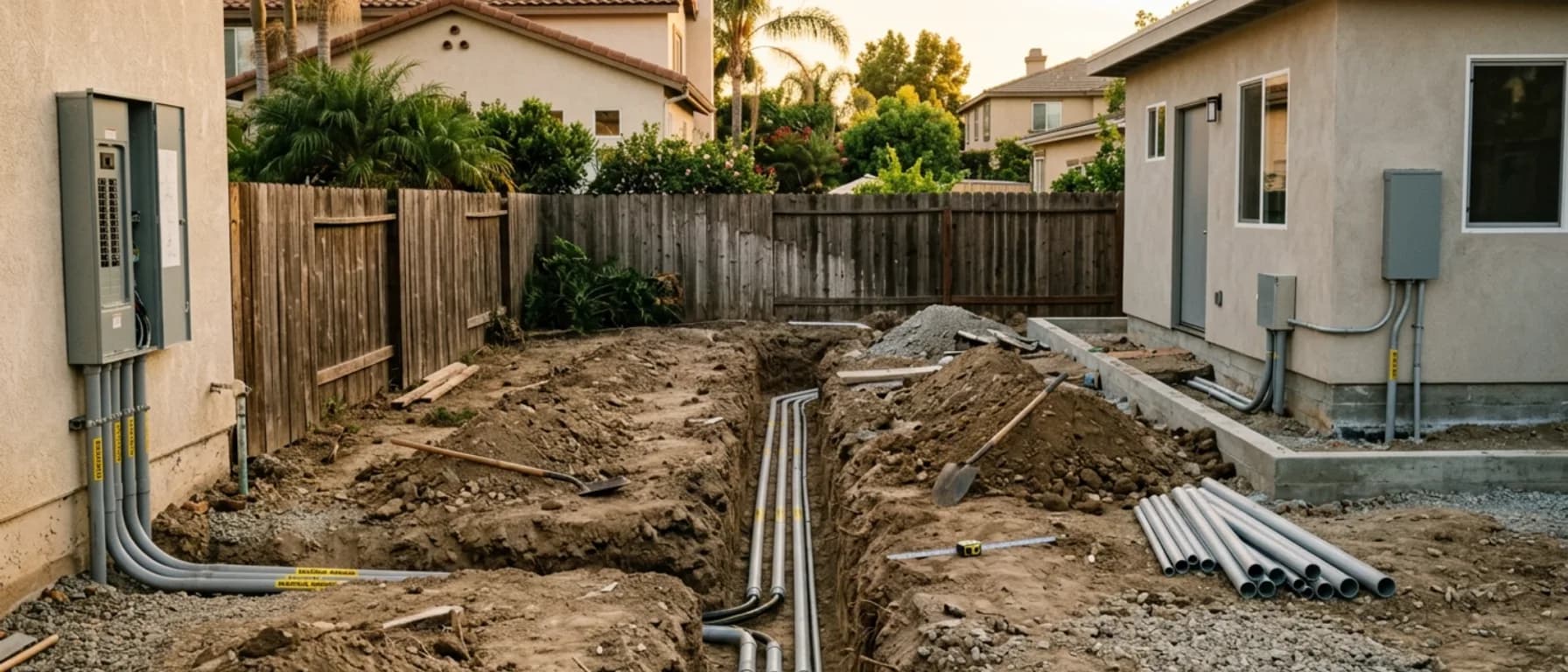
Larger lots are one of the reasons people move to Wildomar and the outskirts of Lake Elsinore. They are also the reason so many properties out here have a detached garage, workshop, barn, or new ADU sitting 60 to 150 feet from the house with a single extension cord running to it.
Doing it properly is not complicated, but there are six decisions that determine the cost, and most homeowners do not know to ask about them.
1. How Much Power Does the Structure Need?
Start with an honest load list, not a guess.
- Storage garage with lights and a few outlets: 30-60 amps is plenty.
- Working shop with a table saw, dust collector, compressor, and welder: 100 amps, often more if a welder and compressor can run together.
- ADU or guest house: a full dwelling load calculation is required — typically 100 amps, and the calculation is not optional for permitting.
- Anything with a mini-split, EV charger, or well pump: add it explicitly, do not round up and hope.
Overbuilding the feeder slightly is cheap. Undersizing it and trenching twice is not.
2. Does the Main Panel Have Capacity?
This is the question that decides whether your project costs $4,000 or $12,000. Feeding a 100-amp subpanel from a 100-amp main service usually means a service upgrade first. Feeding it from a modern 200-amp panel with free spaces is straightforward.
Older properties in this area frequently have 100 or 125-amp service that was adequate in 1985 and is not adequate for a house plus an ADU. If a panel upgrade is needed, do it first — it is the foundation everything else sits on.
3. Trench Depth, Conduit, and Wire
Code sets minimum burial depths that depend on the method. Direct-buried cable needs to go deeper than conductors in rigid metal conduit; PVC conduit sits in between, and the depth changes again under a driveway. In practice, for most residential runs we use PVC conduit at 18 inches minimum, deeper under vehicle traffic.
Two things worth spending on while the trench is open:
- Upsize the conduit. Going from 1-1/4" to 2" costs very little and lets you pull bigger conductors later without digging again.
- Add a second empty conduit for data, a camera run, or irrigation control. Pulling Cat6 to a detached shop later is trivial with a spare conduit and miserable without one.
Voltage drop matters at these distances. A 100-foot run at 100 amps needs larger conductors than the ampacity table alone suggests — we size for 3% or less drop on feeders.
4. The Subpanel Itself
A detached structure subpanel has rules a garage subpanel inside the house does not. Since the 2008 code cycle, four-wire feeders are required: two hots, a neutral, and an equipment ground. The neutral and ground must be kept separate at the subpanel, and the structure needs its own grounding electrode — typically a ground rod or two, bonded to the panel.
If your detached garage was wired before 2008 with a three-wire feeder and a bonded neutral, that is a real hazard worth correcting. It shows up constantly in code correction work out here.
5. Disconnects, GFCI, and Receptacles
The structure needs a disconnecting means, which the subpanel main breaker usually satisfies. All 125V, 15- and 20-amp receptacles in a garage, shop, or unfinished accessory building need GFCI protection. Lighting should be on its own circuit so a tripped tool breaker does not leave you in the dark — a small detail that shop owners appreciate every single time.
For a working shop, plan dedicated circuits for the compressor, dust collection, and any 240V tool, plus more 20-amp general receptacles than you think you need. Outlets every 4 to 6 feet along the bench wall is not overkill.
6. Permits and Inspection
All of this requires a permit. Wildomar and Lake Elsinore issue their own; properties in unincorporated areas go through Riverside County. There will be a trench inspection before backfill — do not cover the trench until it has been signed off, because opening it again is the most avoidable cost on the whole job. ADU projects carry additional plan review; the California Department of Housing and Community Development maintains current statewide ADU standards worth reviewing early.
What It Typically Costs
The wide range you see quoted comes almost entirely from three variables: distance, trenching conditions, and whether the main panel needs upgrading. Rocky decomposed granite, which is common on the hillsides here, costs more to trench than flat soil. Crossing a finished driveway costs more than crossing dirt. Get those three answers and the estimate stops being a mystery.
Get It Scoped Properly
Westek Electric Corp. runs power to detached garages, shops, barns, and ADUs across Wildomar, Lake Elsinore, Menifee, and Winchester — including trenching, subpanels, and permits. Call (909) 996-6678 and we will walk the property and give you a real number.